
What Happens When the Heat Fails in Your Northern Michigan Home?

If a house loses heat during very cold weather, the temperature inside eventually drops...obviously.
Pipes can freeze.
Frozen pipes can burst.
Water damage can follow.
Most homeowners already know that.
The more useful question is what happens between the moment the heat fails and the moment someone discovers there is a problem?
That is where an unoccupied, or vacant, home becomes different.
55°F Is a Common Minimum.
Severe Cold Changes the Conversation
You'll find 55°F used widely as a minimum thermostat setting for a vacant, unoccupied home during cold weather.
Michigan's MIREADY program, for example, advises homeowners who are away to set the thermostat no lower than 55°F to help prevent pipes from freezing.
That doesn't mean 55°F guarantees that pipes won't freeze.
Homes are not all built the same. Plumbing may run through exterior walls, crawl spaces, garages or other areas that are considerably colder than the main living space.
And that's where severe cold deserves a separate consideration.
The Insurance Information Institute recommends keeping a house heated to a minimum of 65°F during severe cold weather.
Its reason is important: the temperature inside the walls where pipes are located can be substantially colder than the temperature in the surrounding room.
So there isn't really a contradiction between 55°F and 65°F.
55°F is a commonly published minimum baseline for an unoccupied home. 65°F is a more conservative recommendation from Triple-I when severe cold is the concern.
That distinction matters in Northern Michigan.
The Bigger Problem May Not Be the Cold
The obvious scenario is a furnace that simply stops working. But a heating failure doesn't necessarily announce itself.
A furnace can stop.
A power outage can shut down the heating system.
A thermostat can malfunction.
A fuel supply problem can interrupt heat.
A mechanical problem can develop while nobody is at the property.
And if the home is occupied, someone notices. If the home is unoccupied, the clock starts running.
That is the part an owner cannot easily manage from hundreds of miles away.
There Isn't a Reliable Countdown
It's tempting to ask: How long does it take for pipes to freeze? There isn't one useful answer.
It depends on outdoor temperature, wind exposure, construction, insulation, plumbing location, interior temperature and how long the heating system has been down.
A pipe inside a well-insulated interior wall is in a very different situation from a pipe exposed to cold air in a crawl space or exterior wall.
That's why simply knowing the thermostat was set to 55°F doesn't tell you what is happening everywhere in the house.
The thermostat tells you what temperature the thermostat is sensing.
It does not necessarily tell you what is happening inside every wall, crawl space or other vulnerable area.
The Real Risk Is Delayed Discovery
This is where the issue becomes less about frozen pipes and more about time.
Suppose a heating system fails during a severe cold snap. If someone is staying at the house, the problem may be discovered quickly. Smart thermostats and other house monitoring devices certainly help. It at least alerts you that there is an issue. Now…what is it?
If someone is not staying in the home and the home is empty but someone is checking the property regularly, (i.e. Home Watch) there is at least an opportunity for the failure to be noticed.
But if nobody is there and it isn’t being monitored otherwise, the house may remain cold for hours or days before anyone knows it.
And the longer a problem goes unnoticed, the fewer options the homeowner has to limit the consequences.
Triple-I recommends regular checks when a home is unoccupied during severe cold and notes that quick action when there is a frozen pipe or water leak could mean substantially less damage.
That's an important distinction.
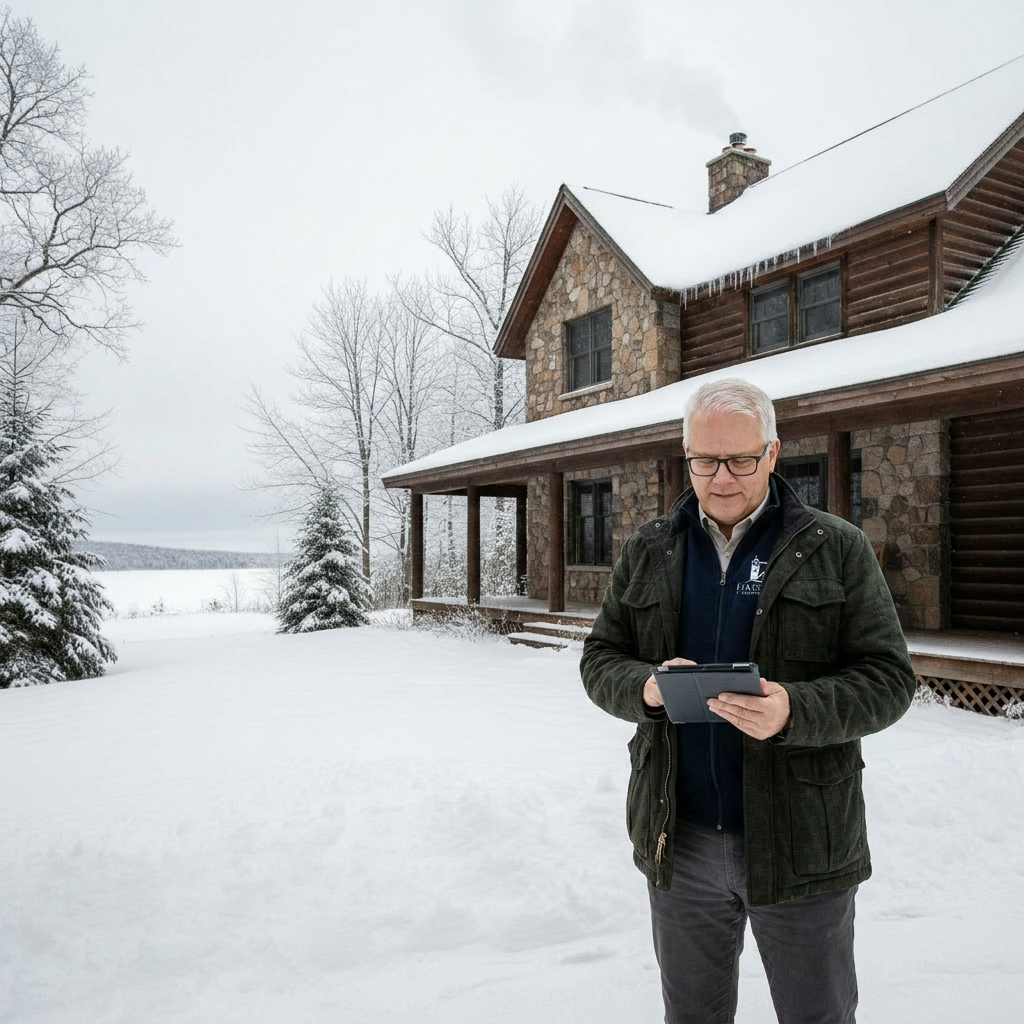
Knowing Something Is Wrong Is Only the First Step
Home Watch doesn't prevent every failure. It can shorten the time between a failure occurring and someone knowing about it.
What Can You Actually Know From a Distance?
A smart thermostat will tell you the temperature has dropped.
A monitoring system will tell you there has been a power interruption.
An alarm system will send you an alert.
Those things can be extremely useful. But an alert is not the same thing as someone being at the property.
You still have to determine:
What actually happened?
Is the heat back on?
Is the house continuing to cool?
Is there visible water damage?
Has a pipe already failed?
Does someone need to get inside?
Does a plumber, HVAC contractor or other professional need to be contacted?
Those are decisions that become more difficult when your are several hours away from your Northern Michigan home.
Finding the Problem Early Changes the Situation
A Home Watch visit isn't a substitute for a heating system, thermostat or water monitoring system.
And it isn't a plumbing inspection.
A Home Watch visit is a visual check of the property for obvious signs of problems.
That distinction matters too.
During a visit, the person checking the home may find that the house feels unusually cold, see an indication of a heating problem, observe water where it shouldn't be or identify another visible condition that warrants attention.
The important thing is not pretending a visual visit can diagnose a mechanical failure. It’s about communicating it promptly and reliably.
That gives you an opportunity to make the next decision.
The Question Isn't Just "Is the Heat On?"
For a Northern Michigan home that sits empty through the winter, a better question is:
How quickly would I know if the heat stopped working and how quickly can I get there?
That's a different question than asking whether the thermostat is set to 55°F.
And it is a much more important question when the house may sit empty for weeks or months.
A thermostat setting is part of the plan.
So is knowing where the main water shutoff is.
So is understanding how the home's plumbing is configured.
So is having someone who can check the property when severe weather hits.
And so is having a reliable way to communicate what was found.
Winter Is the Season.
Severe Cold Is the Stress Test.
Northern Michigan homeowners already know winter requires preparation.
The more important consideration for a vacant home is what happens when conditions move beyond an ordinary winter day.
A prolonged cold snap.
A heating failure.
A power outage.
A mechanical problem.
A frozen pipe.
A burst pipe.
These events don't necessarily happen separately. One failure can create the conditions for the next one.
That is why regular attention to your empty Northern Michigan home matters.
Not because every winter day is an emergency.
But because when something does go wrong, time matters.